

Modern interior design is no longer limited to simple, flat wall colours. Homeowners, interior designers, architects, hotels, offices, restaurants, and commercial spaces are increasingly using decorative finishes to give ordinary walls a more distinctive appearance. One such option is metallic paint for walls.
Metallic wall paint is designed to create decorative special effects by adding shine, depth, texture, and visual interest to interior walls. Depending on the shade, lighting, base colour, and application technique, the finish can range from subtle elegance to a bold luxury effect.
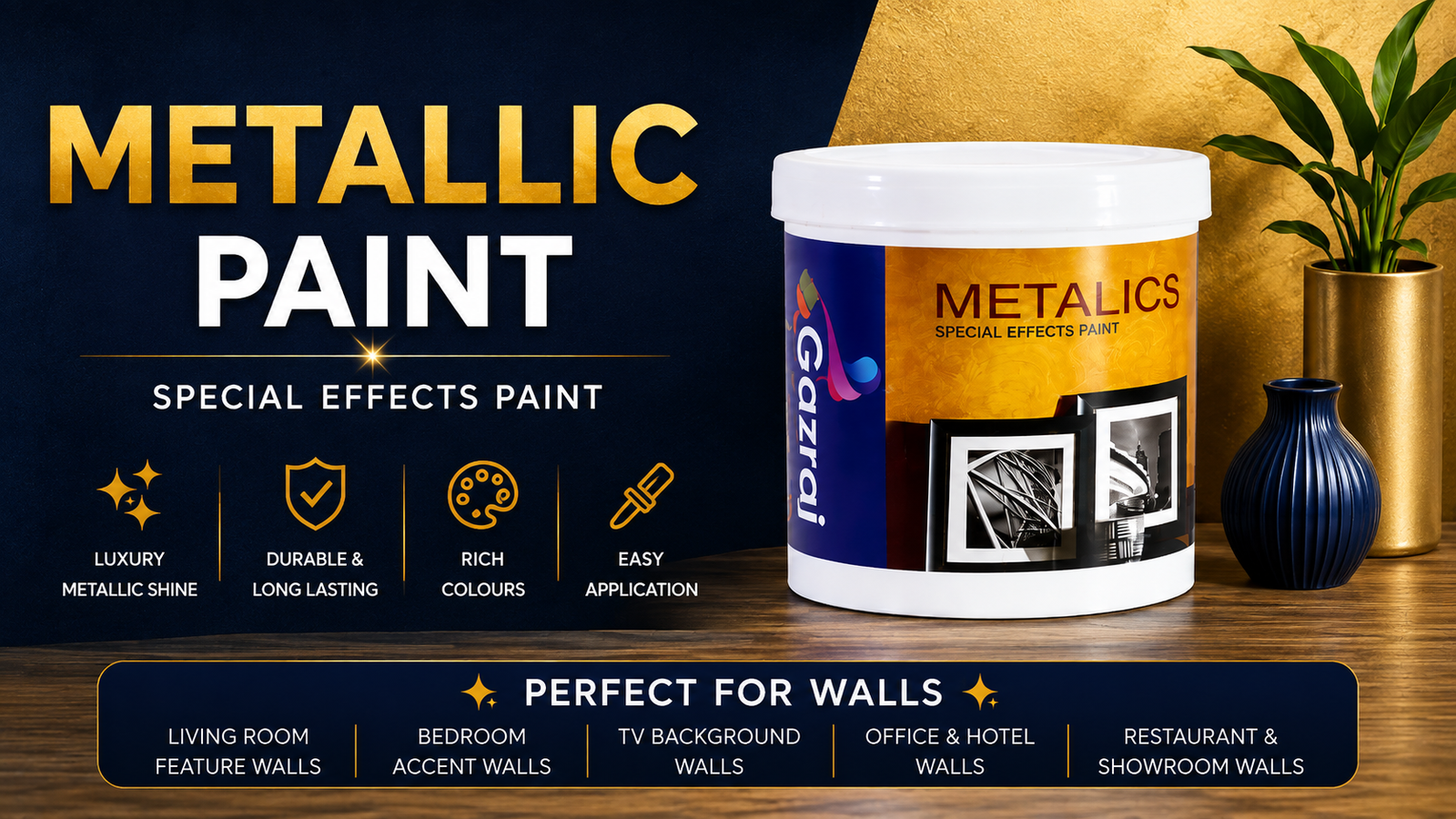
Gazraj Metallics Special Effects Paint is designed for decorative wall applications where a distinctive metallic effect is required.
In this guide, we will explore what metallic wall paint is, its benefits, where it can be used, popular design ideas, surface preparation, application tips, and how to achieve an attractive special-effect finish on interior walls.
What Is Metallic Paint for Walls?
Metallic paint for walls is a decorative coating used to create a metallic or special-effect appearance on interior wall surfaces.
Unlike conventional wall paint, which generally creates a uniform colour, metallic finishes are selected primarily for their decorative effect. The finished surface interacts with natural and artificial light, which can create variations in shine, depth, and appearance.
This makes metallic paint particularly suitable for feature walls and accent walls where the objective is to make a selected area stand out.
The final appearance can vary according to factors such as:
- Metallic shade
- Base colour
- Wall condition
- Application technique
- Number of coats
- Natural lighting
- Artificial lighting
- Viewing angle
Because of these variables, a metallic wall finish can create a distinctive appearance that is difficult to achieve with conventional flat wall colours.
Why Choose Metallic Paint for Interior Walls?
Walls occupy a large visual area in any room and strongly influence the overall interior design.
While conventional paints are suitable for everyday colour applications, metallic wall paint can be used when you want to create a more decorative focal point.
1. Creates a Premium Decorative Appearance
One of the main reasons for choosing metallic paint is its distinctive visual effect.
Metallic finishes can give an ordinary wall a more stylish and sophisticated appearance without requiring major structural changes to the room.
A carefully selected metallic feature wall can become the centre of attention in a living room, bedroom, reception area, office, showroom, hotel, or restaurant.
2. Adds Shine and Visual Depth
Metallic paint interacts with light differently from conventional wall paint.
As natural sunlight or artificial lighting falls on the painted surface, different areas may appear lighter, darker, brighter, or more reflective.
This variation helps create visual depth and makes the wall more noticeable.
3. Ideal for Feature Walls
You do not necessarily need to apply metallic paint to every wall in a room.
In many interiors, the most effective approach is to select one important wall and convert it into a metallic feature wall.
This allows the special effect to stand out while the remaining walls maintain a simpler appearance.
4. Complements Modern Interior Designs
Metallic wall finishes can complement modern, contemporary, premium, and decorative interior themes.
The effect can be paired with suitable flooring, curtains, lighting, artwork, and interior accessories to create a coordinated design.
5. Offers Creative Design Possibilities
The appearance of metallic paint can change depending on the application technique.
This gives interior designers and applicators greater flexibility when creating decorative wall effects.
Where Can Metallic Paint Be Used?
Gazraj Metallics Special Effects Paint is intended for decorative wall applications.
Some suitable interior locations include:
Living Room Feature Walls
The living room is often one of the most visible areas of a home.
Instead of applying metallic paint throughout the room, consider selecting a prominent wall, such as the wall behind a sofa or another focal area.
A metallic effect can help visually separate this wall from the surrounding surfaces.
Bedroom Accent Walls
A bedroom can benefit from a carefully designed accent wall.
For example, the wall behind the bed can be highlighted with a metallic special effect while the other walls use complementary conventional colours.
This creates contrast without making the room visually overwhelming.
TV Unit Background Walls
The wall behind a television unit is another popular location for decorative finishes.
A metallic effect can help define the entertainment area and create a stronger visual focal point.
The selected shade should coordinate with the TV unit, lighting, and surrounding interior colours.
Reception Areas
First impressions are important in commercial interiors.
A metallic feature wall behind a reception desk can help create a distinctive and professional-looking entrance area.
It can be considered for:
- Offices
- Hotels
- Salons
- Studios
- Clinics
- Showrooms
- Other commercial reception spaces
Office Interiors
Metallic paint can also be used selectively in office interiors.
Rather than covering every wall, it can be applied to selected areas such as reception walls, meeting-room feature walls, or prominent interior sections.
Hotels and Restaurants
Hotels, cafés, and restaurants often use decorative wall finishes to create a particular atmosphere.
Metallic special effects can help highlight selected interior walls and complement lighting, furniture, artwork, and other decorative elements.
Showrooms and Retail Spaces
Visual presentation is particularly important in showrooms and retail environments.
A metallic feature wall can provide an attractive background for selected display areas and help differentiate important sections within the space.
Metallic Paint vs Regular Wall Paint
Regular wall paint and metallic paint serve different design purposes.
Regular wall paint is primarily used to provide uniform colour and general surface coverage.
Metallic paint, on the other hand, is primarily selected to create a decorative special effect.
Regular paint usually creates a consistent appearance, whereas metallic paint can produce variations in shine and depth depending on lighting and viewing angle.
This does not mean that one needs to replace the other.
In fact, one of the most effective interior design approaches is to combine them.
For example, three walls in a living room can use a simple neutral colour while the fourth wall is transformed into a metallic accent wall.
This creates contrast while maintaining balance in the room.
Best Places to Create a Metallic Feature Wall
Choosing the right wall is just as important as selecting the metallic shade.
A good feature wall is generally one that naturally attracts attention when someone enters the room.
Some options include:
- Wall behind the sofa
- Wall behind the bed
- TV background wall
- Reception backdrop
- Restaurant feature wall
- Hotel lobby wall
- Office reception wall
- Meeting-room focal wall
- Showroom display wall
- Decorative passage wall
Before selecting a wall, also consider the direction and intensity of lighting.
Since metallic finishes respond strongly to light, lighting conditions can significantly influence the final appearance.
Importance of Lighting with Metallic Wall Paint
Lighting plays an important role in how metallic paint looks after application.
The same metallic shade can appear different under daylight and artificial lighting.
Natural Light
Sunlight can highlight the reflective characteristics of a metallic finish.
The appearance may also change throughout the day as the direction and intensity of sunlight change.
Warm Lighting
Warm artificial lighting can complement certain metallic effects and help create a comfortable, premium atmosphere.
Cool Lighting
Cooler lighting can produce a different visual character and may make certain shades appear sharper.
For this reason, it is useful to evaluate a small sample under the actual lighting conditions of the room before completing the entire feature wall.
How to Prepare a Wall for Metallic Paint
Surface preparation plays an important role in the final appearance of decorative wall paint.
A special-effect coating can make imperfections more noticeable if the underlying wall is not properly prepared.
Step 1: Inspect the Wall
Check the wall for:
- Cracks
- Holes
- Loose material
- Dust
- Grease
- Uneven areas
- Previous loose coating
Any significant surface issue should be addressed before beginning the decorative application.
Step 2: Clean the Surface
The wall should be clean and free from dust, dirt, grease, and loose particles.
Applying paint over a contaminated surface can affect the final finish.
Step 3: Repair Wall Imperfections
Fill suitable cracks, holes, and uneven areas using the appropriate repair material.
Allow repaired sections to dry properly before proceeding.
Step 4: Create a Smooth Base
A smooth and properly prepared wall helps produce a more consistent metallic appearance.
Complete the required sanding or surface preparation according to the wall condition and coating system.
Step 5: Apply the Recommended Base Coat
The base colour can influence the final appearance of some metallic effects.
Use the appropriate base coat or primer recommended for the specific product and desired finish.
Allow it to dry properly before applying the metallic coating.
How to Apply Metallic Paint on Walls
The exact application process should always follow the instructions provided for the product.
However, the general process includes the following stages.
1. Prepare the Wall
Make sure the surface is clean, dry, smooth, and properly prepared.
2. Prepare the Base
Apply the recommended base coat and allow it to dry as instructed.
3. Mix the Metallic Paint
Mix the paint properly before application according to the product instructions.
This helps maintain a more consistent finish.
4. Apply the Metallic Coating
Use the recommended application tool and technique.
Application direction, pressure, overlap, and coating thickness can influence the final special effect, so maintaining a consistent technique is important.
5. Allow Proper Drying
Follow the recommended drying and recoating times.
Avoid rushing the application by applying another coat before the previous layer has dried sufficiently.
6. Inspect the Final Effect
Once dry, examine the wall under the room’s normal lighting conditions.
The final metallic effect may look different depending on the direction of light and viewing angle.
Tips for Getting a Better Metallic Wall Finish
Metallic decorative finishes require more attention to application technique than ordinary flat wall colours.
Always Test a Small Area First
Before applying metallic paint to an entire wall, create a small test section.
Observe it under both daylight and artificial lighting.
This helps you evaluate whether the shade and effect suit the room.
Prepare the Wall Properly
Do not use metallic paint to hide significant wall defects.
A smooth, properly prepared surface generally produces a cleaner decorative appearance.
Maintain a Consistent Technique
Changing the direction, pressure, or application technique halfway through a wall may create unwanted visual variations.
Consider the Surrounding Colours
A metallic feature wall should complement the rest of the interior.
Consider:
- Other wall colours
- Flooring
- Curtains
- Lighting
- Ceiling colour
- Artwork
- Interior décor
The goal should be to create a balanced interior rather than simply making one wall as shiny as possible.
Common Mistakes to Avoid with Metallic Wall Paint
Even a good decorative paint may not deliver the expected appearance if it is applied incorrectly.
Poor Surface Preparation
Dust, cracks, holes, and uneven areas can affect the final result.
Choosing the Shade Without Testing
A colour sample can look different once applied to a large wall.
Always test the selected finish under actual room lighting.
Applying Excessively Thick Coats
More paint does not automatically create a better metallic effect.
Follow the recommended application procedure.
Inconsistent Application
Changes in application direction and pressure may become noticeable after drying.
Ignoring Lighting
Metallic finishes interact with light, so the position of windows, ceiling lights, wall lights, and decorative lighting should be considered.
Applying It Everywhere
Metallic paint can be visually strong.
In many cases, a single feature wall creates a more balanced result than covering every wall in the room.
How to Choose the Best Metallic Paint for Walls
When searching for the best metallic paint for walls, consider more than just the colour.
Desired Special Effect
Decide whether you want a subtle metallic effect or a more prominent decorative appearance.
Wall Location
Consider where the wall is positioned and how visible it will be.
Lighting Conditions
Evaluate how much natural and artificial light reaches the wall.
Existing Interior Colours
Select a metallic shade that complements the rest of the room.
Application Requirements
Understand the recommended surface preparation, base coat, tools, number of coats, and drying requirements before beginning the project.
Gazraj Metallics Special Effects Paint for Walls
Gazraj Metallics Special Effects Paint is designed for decorative interior wall applications where a distinctive metallic appearance is desired.
It can be considered for creating special-effect feature walls in residential and commercial interiors.
Possible wall applications include:
- Living room feature walls
- Bedroom accent walls
- TV background walls
- Reception walls
- Office feature walls
- Hotel interiors
- Restaurant interiors
- Showroom walls
- Retail display backgrounds
The final appearance depends on the selected shade, wall preparation, base colour, application technique, and lighting conditions.
For best results, follow the recommended application procedure for Gazraj Metallics Special Effects Paint.
Metallic Wall Design Ideas
If you are planning to use metallic paint but are unsure where to start, consider these design ideas.
Metallic Wall Behind the Sofa
Create a focal point in the living room by applying the special effect to the wall behind the main sofa.
Metallic Bedroom Feature Wall
Highlight the wall behind the bed while keeping the remaining walls in complementary neutral shades.
Metallic TV Background
Use the metallic finish on the TV background wall to visually separate the entertainment area.
Metallic Reception Wall
A metallic backdrop behind a reception desk can help create a distinctive entrance for offices, hotels, salons, and other commercial spaces.
Metallic Showroom Feature Wall
Use a special-effect wall as a background for an important display section.
Frequently Asked Questions
What is metallic paint for walls?
Metallic paint for walls is a decorative coating designed to create a metallic or special-effect appearance on interior wall surfaces.
Where can Gazraj Metallics Special Effects Paint be used?
Gazraj Metallics Special Effects Paint is intended for decorative wall applications such as feature walls and accent walls in suitable residential and commercial interiors.
Can metallic paint be used on a living room wall?
Yes, metallic paint can be used to create a decorative feature wall in a living room. The wall behind a sofa or another focal area can be a suitable location.
Is metallic paint suitable for bedroom walls?
It can be used on a selected bedroom accent wall, such as the wall behind the bed, to create a decorative special effect.
Can I apply metallic paint to every wall?
It is possible to design interiors in different ways, but metallic finishes are often most effective when used selectively on feature or accent walls.
Does lighting affect metallic paint?
Yes. Natural and artificial lighting can significantly influence the appearance of a metallic wall finish because the surface interacts with light.
Does the wall need preparation before applying metallic paint?
Yes. The wall should be properly cleaned and prepared according to the recommended coating system. Cracks, holes, loose material, and significant unevenness should be addressed before application.
Is Gazraj Metallics Special Effects Paint meant for furniture?
No. Gazraj Metallics Special Effects Paint discussed in this guide is intended for decorative special-effect applications on walls, not furniture.
Is metallic special effects paint a waterproofing coating?
No. A decorative metallic special-effect wall paint and a roof waterproofing coating have different purposes. Use a dedicated waterproofing product when waterproof protection is required.
Conclusion
Interior walls do much more than divide spaces. With the right decorative finish, they can become an important part of the overall interior design.
Metallic paint for walls offers a way to create distinctive feature walls with shine, depth, and special visual effects. It can be particularly effective in living rooms, bedrooms, reception areas, offices, hotels, restaurants, showrooms, and other interior spaces where a decorative focal point is desired.
The final result depends not only on the selected metallic shade but also on proper wall preparation, base colour, application technique, and lighting.
Gazraj Metallics Special Effects Paint is designed for decorative wall applications and can be used to transform selected interior walls into attractive feature areas with a distinctive metallic effect.
For the best finish, prepare the wall correctly and follow the recommended product application process.