

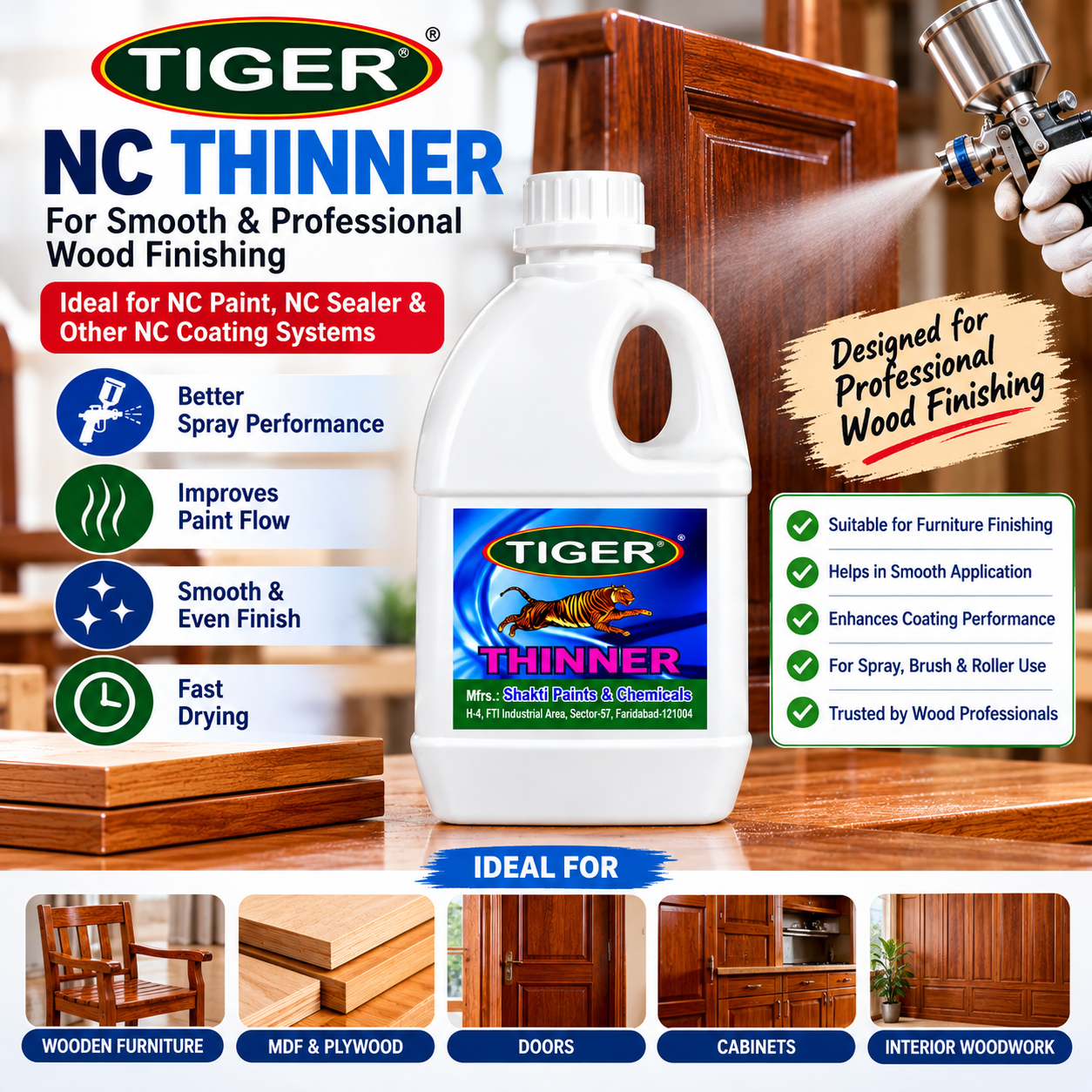
NC thinner is an important material used with compatible Nitrocellulose (NC) paints, lacquers, sealers and other NC-based coating systems. In professional wood finishing, the right thinner helps bring a coating to a workable consistency so it can be applied more smoothly and evenly.
For furniture manufacturers, carpenters, polishers, painters and wood-finishing professionals, choosing a suitable NC thinner for wood finishing can make a significant difference in application quality.
But NC thinner is not simply a general-purpose solvent. It is formulated to work with compatible NC coating systems and should be selected according to the coating manufacturer’s recommendations.
In this guide, we will explain what NC thinner is, how NC thinner works, its uses, benefits, applications and important tips for achieving a better NC finish on wooden surfaces.
What Is NC Thinner?
NC thinner, also known as Nitrocellulose thinner, is a solvent blend designed for use with compatible Nitrocellulose-based paints, lacquers, sealers and coatings.
Its primary purpose is to adjust the consistency or viscosity of an NC coating so that the material can be applied properly using the intended application method.
When an NC coating is too thick, it may not flow or atomize properly during spray application. A suitable NC thinner can help bring the coating to an appropriate working consistency, supporting better flow and application.
NC lacquer systems have traditionally been used in wood and furniture finishing because they can dry relatively quickly and can be applied in multiple coats.
In simple words:
NC Paint + Compatible NC Thinner = Better Working Consistency for Application
However, the correct quantity depends on the particular NC product, application method and manufacturer’s technical instructions. There is no universal mixing ratio that should be applied to every NC coating.
What Is NC Thinner Used For?
NC thinner is primarily used with compatible NC-based coating systems for viscosity adjustment and application support.
Common applications include:
- NC paints
- NC lacquers
- NC sealers
- NC primers
- Wood finishing systems
- Furniture finishing
- Spray application of compatible NC coatings
- Professional coating and finishing work
In wood-finishing operations, compatible lacquer thinner is used to help coatings reach a workable consistency for application.
NC Thinner for Wood Furniture
Furniture finishing is one of the common applications associated with NC coating systems.
NC coatings can be used on different interior wood surfaces where a fast-drying coating system is required. Furniture manufacturers and finishing professionals may use NC systems on:
- Tables
- Chairs
- Wardrobes
- Cabinets
- Wooden doors
- Decorative wooden panels
- Interior furniture
- MDF-based furniture
- Plywood furniture
The quality of the final finish depends on much more than the thinner alone. Surface preparation, sanding, coating selection, application equipment, environmental conditions and drying practices all influence the final result.
How Does NC Thinner Work With NC Paint?
NC thinner helps adjust the viscosity of a compatible NC coating.
For example, if an NC coating is too thick for the intended spray application, it may not atomize or flow as expected. Using the recommended compatible thinner in the appropriate quantity can help achieve a more workable consistency.
A properly prepared coating can support:
- Better spray flow
- More uniform application
- Improved leveling
- Consistent coating thickness
- Easier application
- A smoother-looking finish
The exact amount of thinner should always be determined from the product’s technical instructions rather than using a fixed ratio for every NC paint.
Benefits of Using the Right NC Thinner
1. Helps Adjust Coating Viscosity
One of the main functions of NC thinner is viscosity adjustment.
A coating that is too thick can be difficult to apply evenly. The correct compatible thinner can help bring the coating to a suitable working consistency.
2. Supports Better Spray Application
NC thinner can help an NC coating achieve a consistency suitable for spray equipment when used according to the coating manufacturer’s instructions.
This is particularly useful for furniture workshops and professional wood-finishing operations.
3. Supports Smooth Flow
A compatible thinner can help the coating flow more evenly across the prepared surface.
This can contribute to a cleaner and more uniform appearance when the complete finishing process is carried out correctly.
4. Helps Maintain Consistent Application
In professional furniture production, consistency matters.
Using the same compatible coating system and following a controlled thinning/application process can help reduce unnecessary variation between pieces or production batches.
5. Useful for Professional Wood Finishing
NC thinner is commonly associated with NC-based wood finishing systems, making it relevant for furniture manufacturers, carpenters, polishers and professional painters.
NC Thinner vs General Purpose Thinner
NC thinner and general-purpose thinner should not automatically be treated as interchangeable products.
NC thinner is formulated for compatible Nitrocellulose-based coating systems, whereas a general-purpose thinner may be formulated for other coating requirements.
Using an unsuitable thinner can affect:
- Coating compatibility
- Flow
- Drying behavior
- Finish appearance
- Spray performance
- Overall coating performance
Therefore, always check the coating manufacturer’s recommendations before selecting a thinner.
NC Thinner vs PU Thinner
NC thinner and PU thinner are designed for different coating systems.
NC thinner is intended for compatible Nitrocellulose-based coatings.
PU thinner is intended for compatible Polyurethane coating systems.
Although both products are called “thinner,” they should not be considered interchangeable.
The correct thinner should be selected according to the paint or coating system being used.
Simple comparison
| Feature | NC Thinner | PU Thinner |
|---|---|---|
| Main system | NC / Nitrocellulose | PU / Polyurethane |
| Primary role | Viscosity & application support | Viscosity & application support |
| Typical use | NC paint, lacquer, sealer | PU paint and compatible PU coatings |
| Suitable for | Compatible NC systems | Compatible PU systems |
How to Use NC Thinner Correctly
Using NC thinner correctly is important for achieving consistent results.
Step 1: Identify the coating system
First, confirm that the product you are using is compatible with NC thinner.
Do not assume that every paint or coating can be thinned with NC thinner.
Step 2: Read the product instructions
Check the technical data sheet or manufacturer’s application instructions for the recommended thinner and mixing guidance.
Step 3: Prepare the surface
Before applying NC coating, make sure the wooden surface is properly prepared.
Remove dust, dirt and loose material and complete the required sanding process.
Step 4: Mix carefully
Add the recommended amount of compatible NC thinner according to the coating manufacturer’s instructions.
Mix thoroughly and avoid adding excessive thinner.
Step 5: Test the coating
Before applying the material to the complete furniture piece, test it on a suitable prepared surface or sample.
Check:
- Flow
- Spray pattern
- Coverage
- Drying behavior
- Surface appearance
Step 6: Apply the coating
Apply the NC coating using the recommended application method and equipment.
For spray application, proper equipment settings and technique are important for achieving a consistent finish.
Step 7: Allow proper drying
Allow the coating to dry according to the manufacturer’s instructions and environmental conditions before applying additional coats or handling the finished surface.
Common NC Thinner Mistakes to Avoid
Even a good-quality NC thinner cannot compensate for poor surface preparation or incorrect application.
Mistake 1: Using too much thinner
Adding excessive thinner can change the coating’s working characteristics and may reduce the desired film build.
Always follow the coating manufacturer’s recommended instructions.
Mistake 2: Using the wrong thinner
A thinner designed for one coating system should not automatically be used with another coating system.
For example, NC thinner and PU thinner should be selected according to their respective compatible coating systems.
Mistake 3: Ignoring surface preparation
Dust, grease, uneven sanding and surface contamination can negatively affect the final appearance.
Proper preparation should come before coating application.
Mistake 4: Applying one heavy coat
Trying to achieve the entire finish with one heavy coat can create application problems.
Controlled, even coats according to the coating system’s instructions generally provide better control.
Mistake 5: Ignoring environmental conditions
Temperature, humidity, ventilation and application conditions can influence solvent evaporation and coating behavior.
Fast solvent evaporation under unsuitable conditions can contribute to finishing defects such as blushing.
How to Get a Smooth NC Finish on Wood
For a professional-looking NC finish, focus on the complete finishing process rather than the thinner alone.
Follow these basic practices:
- Prepare the wood surface properly.
- Sand the surface using suitable sandpaper.
- Remove sanding dust before coating.
- Use a compatible NC sealer or coating where required.
- Use the recommended NC thinner.
- Follow the manufacturer’s mixing instructions.
- Apply controlled and even coats.
- Maintain suitable application conditions.
- Allow appropriate drying between coats.
- Inspect the finish before final polishing or further treatment.
A smooth finish is normally the result of several controlled steps working together.
NC Thinner for Spray Painting
Spray application is commonly used for professional furniture and wood finishing because it can provide an even coating when the material, equipment and technique are properly matched.
NC thinner can help adjust a compatible NC coating to a suitable working viscosity for spray application.
However, spray quality also depends on:
- Spray gun setup
- Nozzle size
- Air pressure
- Material viscosity
- Spray distance
- Operator technique
- Surface preparation
- Environmental conditions
Therefore, changing only the thinner quantity may not solve every spray-related problem.
NC Thinner for MDF and Plywood Furniture
NC finishing systems may also be used on furniture manufactured from materials such as MDF and plywood, depending on the complete coating system.
Before application, the substrate should be properly prepared and the selected NC products should be confirmed as suitable for the intended surface.
For MDF furniture, particular attention should be given to:
- Edge preparation
- Sanding
- Sealing
- Dust removal
- Coating compatibility
For plywood furniture, the surface condition and veneer quality can also affect the final appearance.
How to Choose an NC Thinner
When choosing an NC thinner, consider the following factors:
Compatibility
The most important factor is compatibility with the NC coating you are using.
Application Method
Consider whether the coating will be applied by spray, brush or another approved method.
Finishing Requirement
Different furniture and wood-finishing projects can have different appearance requirements.
Product Quality
Choose a consistent, professionally formulated product from a reliable manufacturer.
Technical Support
For commercial furniture production, technical guidance can be useful when selecting the correct coating and thinner combination.
Why Consistent Thinning Matters in Furniture Production
For a single furniture piece, small differences in application may sometimes be difficult to notice.
In commercial production, however, inconsistency can become much more visible.
If different batches are thinned or applied differently, the resulting finish can vary in appearance and application behavior.
A controlled process helps furniture manufacturers maintain greater consistency across multiple pieces.
This includes:
- Measuring materials consistently
- Following the coating manufacturer’s instructions
- Using compatible thinner
- Maintaining application settings
- Keeping surface preparation consistent
- Recording production parameters where appropriate
Frequently Asked Questions About NC Thinner
What is NC thinner?
NC thinner is a solvent blend designed for use with compatible Nitrocellulose-based paints, lacquers, sealers and coating systems. Its primary role is viscosity adjustment and application support.
What is NC thinner used for?
NC thinner is commonly used with compatible NC paints, lacquers, sealers and other Nitrocellulose coating systems, particularly in wood and furniture finishing applications.
Can NC thinner be used with PU paint?
NC thinner should not automatically be used with PU paint. PU coatings generally require their own compatible PU thinner. Always follow the coating manufacturer’s recommendations.
Can NC thinner be used for wood furniture?
Yes, compatible NC coating systems are commonly used in furniture and wood finishing. NC thinner can support the application of these coatings when used according to the product instructions.
Is NC thinner the same as paint thinner?
No. The term “paint thinner” can refer to different solvent products. NC thinner is specifically formulated for compatible Nitrocellulose-based coating systems.
Can I use any thinner with NC paint?
No. The thinner should be compatible with the particular NC paint or coating system. Always check the product’s technical instructions before mixing.
Does NC thinner improve paint finish?
NC thinner can support proper viscosity, flow and application when used correctly. However, the final finish also depends on surface preparation, coating quality, spray technique, drying conditions and other factors.
How much NC thinner should be added to NC paint?
There is no single universal ratio for every NC paint. Follow the specific manufacturer’s technical data sheet or application instructions for the recommended quantity.
Conclusion
NC thinner plays an important supporting role in compatible Nitrocellulose coating systems. In wood and furniture finishing, it can help adjust coating viscosity and support smooth, controlled application.
However, achieving a professional finish requires more than simply adding thinner. The right NC coating, compatible thinner, surface preparation, application technique and drying conditions all work together to determine the final result.
For furniture manufacturers, carpenters, polishers and professional painters, choosing a reliable NC thinner for wood finishing and following the coating manufacturer’s instructions can help create a more consistent finishing process.
Gazraj provides NC Thinner solutions for professional finishing applications. For product selection and application guidance, contact Gazraj and discuss your specific NC coating and finishing requirement.
Explore Gazraj NC Thinner →
Explore Gazraj NC Paint →
Explore Gazraj NC Sealer →