

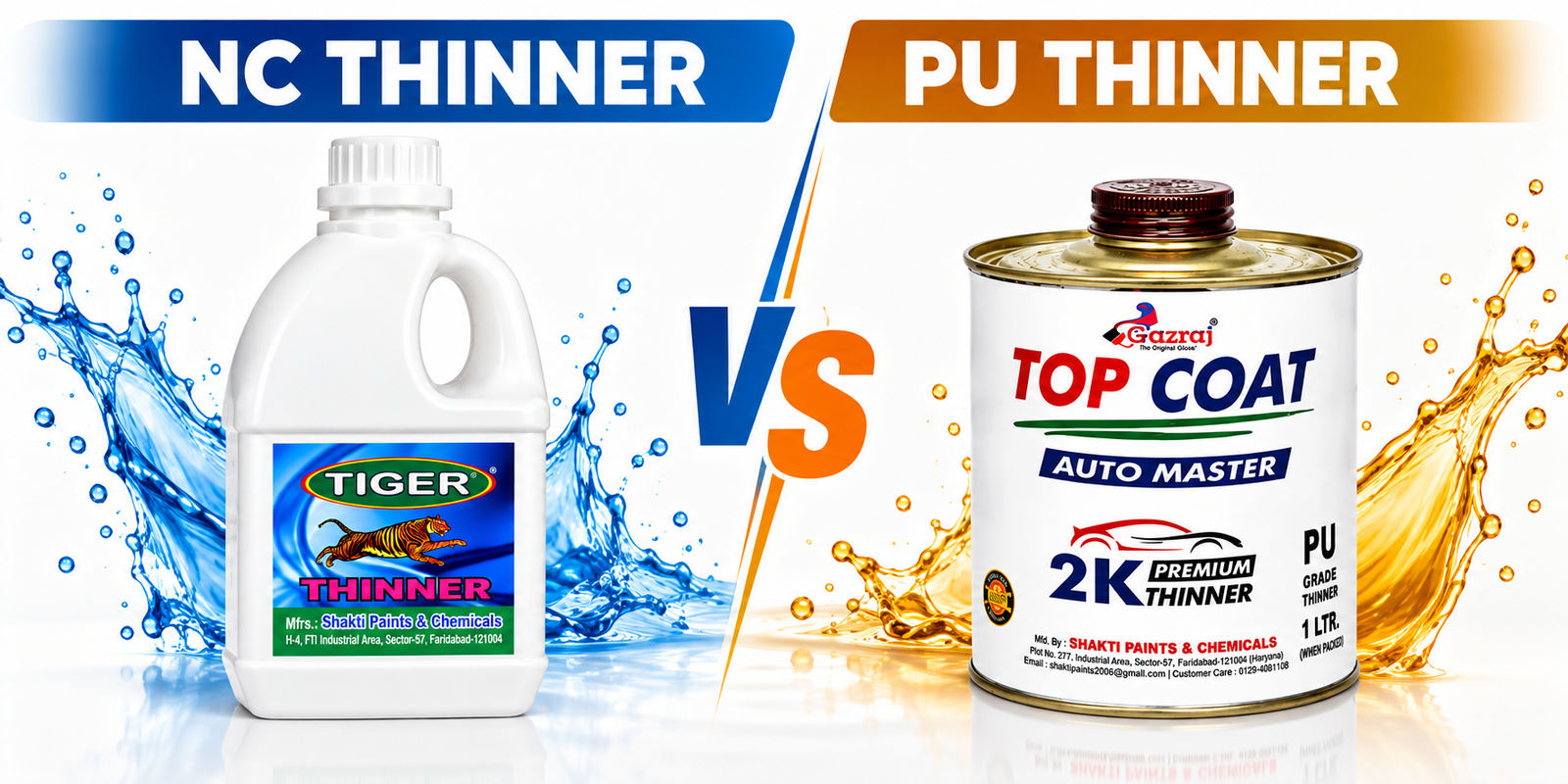
NC Thinner vs PU Thinner:
Choosing the right thinner is an important part of achieving consistent results in professional wood and furniture finishing. Although NC Thinner and PU Thinner are both used to adjust the application consistency of coatings, they are designed for different coating systems.
NC Thinner is generally associated with compatible Nitrocellulose (NC) coatings, while PU Thinner is designed for compatible Polyurethane (PU) coating systems. Because their formulations and intended applications are different, one should not automatically be substituted for the other. Gazraj
For furniture manufacturers, carpenters, painters, polishers, interior contractors and wood-finishing professionals, understanding the difference between NC Thinner and PU Thinner can help in selecting the appropriate product for a particular coating system.
In this guide, we will compare NC Thinner vs PU Thinner, explain their applications, discuss their differences and help you understand which type of thinner is suitable for different wood-finishing requirements.
NC Thinner vs PU Thinner at a Glance
| Feature | NC Thinner | PU Thinner |
|---|---|---|
| Full form | Nitrocellulose Thinner | Polyurethane Thinner |
| Designed for | Compatible NC coating systems | Compatible PU coating systems |
| Common application | NC paint, lacquer and sealer systems | PU paint, sealer, primer and topcoat systems |
| Wood finishing | Commonly used in NC wood-finishing systems | Commonly used in PU wood-finishing systems |
| Main role | Helps achieve suitable application consistency | Helps achieve suitable application consistency |
| Spray application | Can support spray application when recommended | Can support spray application when recommended |
| Interchangeable | No, compatibility must be confirmed | No, compatibility must be confirmed |
The key difference is not simply the word “thinner.” It is the coating system that the thinner is designed to work with.
What Is NC Thinner?
NC Thinner, or Nitrocellulose Thinner, is a solvent blend intended for use with compatible Nitrocellulose-based paints, lacquers, sealers and related coating systems.
Its primary purpose is to help adjust the consistency or viscosity of an NC coating so that it can be applied using the recommended application method.
In wood and furniture finishing, NC coating systems are used on surfaces such as furniture, cabinets, doors, panels and other wooden components.
When the coating is too thick for the intended application method, a compatible NC Thinner can help bring it to a more workable consistency.
Common NC Thinner applications include:
- NC paint application
- NC lacquer systems
- NC sealer application
- Wood and furniture finishing
- Spray application with compatible NC coatings
- Professional refinishing work
The exact amount of thinner should always be determined from the technical instructions for the specific coating being used. There is no single universal NC Thinner mixing ratio suitable for every product. Gazraj
What Is PU Thinner?
PU Thinner stands for Polyurethane Thinner. It is formulated for use with compatible polyurethane coating systems.
PU coatings are commonly used in professional furniture and wood finishing where the coating system is selected according to the desired appearance, performance and application requirements.
Depending on the particular PU system, applications can include:
- PU sealer
- PU primer
- PU clear coat
- PU pigmented topcoat
- Furniture finishing
- Wooden doors and panels
- Professional spray finishing
A suitable PU Thinner can help adjust the coating to an appropriate application consistency and support suitable flow and leveling when used according to the coating manufacturer’s instructions. Gazraj
NC Thinner vs PU Thinner: What Is the Main Difference?
The biggest difference between NC Thinner and PU Thinner is compatibility with the coating system.
NC Thinner → NC Coating System
If the coating system is based on Nitrocellulose, the appropriate compatible NC Thinner should be used according to the manufacturer’s recommendations.
PU Thinner → PU Coating System
If the coating system is polyurethane-based, the appropriate PU Thinner should be selected according to the specific PU product’s requirements.
This distinction is important because using a thinner simply because it is available can create application or finishing problems.
NC Thinner vs PU Thinner for Wood Furniture
Wood furniture can be finished using different coating systems, and the choice between NC and PU depends on the finishing system being used.
NC Thinner for Furniture Finishing
When a furniture manufacturer is working with an NC coating system, an appropriate NC Thinner can help the coating reach a suitable application consistency.
NC systems can be relevant for:
- Furniture
- Cabinets
- Wooden doors
- Decorative panels
- Interior wood products
- Refinishing applications
The correct thinner can support proper flow and application when used with the compatible coating system.
PU Thinner for Furniture Finishing
PU Thinner is used with compatible polyurethane systems for furniture and wood finishing.
It can be relevant for:
- Premium furniture finishing
- Wooden doors
- Cabinets
- Tables
- Panels
- Professional furniture production
- Spray-applied PU systems
The final result depends on more than the thinner alone. Surface preparation, coating selection, application equipment, environmental conditions and application technique can all affect the finish. Gazraj
NC Thinner vs PU Thinner for Spray Application
Spray application requires the coating to have an appropriate working consistency.
If a compatible NC coating is being sprayed, an NC Thinner may be used according to the coating manufacturer’s instructions.
Similarly, when a compatible PU coating is being sprayed, the recommended PU Thinner may be used to achieve the required application characteristics.
However, spray performance is affected by several factors, including:
- Spray equipment
- Nozzle selection
- Coating viscosity
- Temperature
- Humidity
- Application technique
- Thinner compatibility
Therefore, simply adding more thinner is not a solution for every spray-finishing problem.
Can NC Thinner Be Used With PU Paint?
NC Thinner should not automatically be used with PU Paint.
PU coatings are generally designed to work with compatible PU thinning systems. Using an NC Thinner with a PU coating without confirmation from the coating manufacturer can affect application characteristics and final finish.
If you are using PU Paint, check the product’s technical instructions and use the recommended compatible PU Thinner.
Can PU Thinner Be Used With NC Paint?
Similarly, PU Thinner should not automatically be used with NC Paint.
NC coatings should be used with the thinner recommended for their specific NC system.
Even though both products are called “thinner,” their intended coating systems are different.
Simple rule:
NC Paint → Compatible NC Thinner
PU Paint → Compatible PU Thinner
This simple distinction can help avoid unnecessary compatibility problems.
Can NC Thinner and PU Thinner Be Mixed?
It is not recommended to mix NC Thinner and PU Thinner simply to create a universal thinner.
Different thinner formulations can have different solvent characteristics and are designed around specific coating systems.
Mixing different thinner types without proper formulation or compatibility testing can affect:
- Flow
- Drying behavior
- Application consistency
- Coating appearance
- Leveling
- Overall finishing performance
Therefore, use the thinner specified for the coating system rather than creating your own mixture. Gazraj
Which Is Better: NC Thinner or PU Thinner?
There is no universal answer that one is always better.
The correct question is:
Which coating system are you using?
If you are using an NC coating:
Choose the compatible NC Thinner recommended for that coating.
If you are using a PU coating:
Choose the compatible PU Thinner recommended for that coating.
The thinner should be considered part of the complete coating system rather than an independent product.
Factors to Consider Before Choosing a Thinner
1. Type of Coating
First identify whether the coating is:
- NC
- PU
- Melamine
- Another compatible coating system
Do not select a thinner only by its name.
2. Application Method
Consider whether the coating will be applied through:
- Spray
- Brush
- Roller
- Another manufacturer-approved method
Different application methods may require different application consistencies.
3. Manufacturer’s Recommendation
Always check the technical instructions provided for the coating.
This is especially important for professional production environments.
4. Desired Finish
The required appearance can also influence the choice of coating system and application process.
5. Production Requirements
Furniture manufacturers and commercial users should also consider consistency, repeatability and reliable product supply.
Common Mistakes When Choosing NC or PU Thinner
Mistake 1: Choosing a thinner only because it is cheaper
Price should not be the only consideration.
Compatibility with the coating system is more important.
Mistake 2: Assuming all thinners are interchangeable
They are not.
NC Thinner and PU Thinner are designed around different coating systems.
Mistake 3: Adding excessive thinner
More thinner does not automatically mean better flow or better finish.
Always follow the coating manufacturer’s recommended instructions.
Mistake 4: Using a fixed ratio for every product
There is no universal thinning ratio for every NC or PU coating.
Product formulation and application requirements can vary.
Mistake 5: Ignoring surface preparation
A good coating and compatible thinner cannot compensate for poor surface preparation.
The surface should be properly prepared before coating application.
Mistake 6: Skipping a small test
For professional furniture work, testing the complete coating system on a small compatible surface can help identify potential issues before large-scale application.
NC Thinner vs PU Thinner: Quick Decision Guide
Use this simple guide before selecting your thinner:
Are you using NC Paint?
➡️ Use the compatible NC Thinner recommended for the coating.
Are you using PU Paint?
➡️ Use the compatible PU Thinner recommended for the coating.
Are you unsure which thinner is compatible?
➡️ Check the coating manufacturer’s technical instructions.
Are you thinking about mixing NC and PU Thinner?
➡️ Don’t assume they can be mixed. Compatibility should be established through proper technical testing.
Why Choosing the Correct Thinner Matters
A thinner is not simply added to make paint “more liquid.”
The correct thinner can help a compatible coating achieve the application characteristics required for the intended finishing process.
For professional wood finishing, several elements work together:
Surface preparation + Correct coating + Compatible thinner + Correct application method + Proper drying
When these factors are controlled, it becomes easier to achieve a consistent and professional-looking finish.
Gazraj NC and PU Thinner Solutions
Gazraj, formerly Shakti Paints and Chemicals, manufactures and supplies paints, thinners and wood-finishing products for professional users and businesses in India. Its thinner range includes products for different coating and finishing applications, including PU and NC systems. Gazraj
For users working with compatible NC coatings, Gazraj offers NC thinner products designed for NC-related finishing applications.
For compatible polyurethane systems, Gazraj offers PU Thinner for professional wood and coating applications. Gazraj
Before using any thinner, users should verify compatibility with the particular coating and follow the relevant product instructions.
Internal link suggestions:
- Anchor: NC Thinner → your existing NC Thinner article/product page
- Anchor: PU Thinner → your existing PU Thinner article/product page
- Anchor: NC Paint → NC Paint category/product page
- Anchor: Gazraj Thinner range → Thinner category page
Frequently Asked Questions
Is NC Thinner the same as PU Thinner?
No. NC Thinner is intended for compatible Nitrocellulose coating systems, while PU Thinner is intended for compatible Polyurethane coating systems.
Which thinner is used for NC Paint?
A compatible NC Thinner recommended for the particular NC coating system should be used.
Which thinner is used for PU Paint?
A compatible PU Thinner recommended for the particular polyurethane coating should be used.
Can NC Thinner be used with PU Paint?
NC Thinner should not automatically be used with PU Paint. Check the coating manufacturer’s compatibility and technical instructions.
Can PU Thinner be used with NC Paint?
PU Thinner should not automatically be used with NC Paint. Use the thinner recommended for the NC coating system.
Can NC Thinner and PU Thinner be mixed?
They should not be mixed simply to create a universal thinner. Proper compatibility and formulation testing would be required.
Which thinner is better for wood furniture?
Neither is universally better. The correct choice depends on the coating system. NC coatings require compatible NC thinning systems, while PU coatings require compatible PU thinning systems.
Does thinner improve paint flow?
A compatible thinner can help adjust the application consistency of a coating and support suitable flow and leveling. The result also depends on the coating, surface preparation, equipment and application conditions.
Is a higher amount of thinner always better?
No. Excessive thinning can change the coating’s application characteristics. Always follow the specific coating manufacturer’s instructions.
Final Thoughts
Understanding the difference between NC Thinner and PU Thinner is important for anyone involved in professional wood and furniture finishing.
The key point is simple:
NC coating system → compatible NC Thinner
PU coating system → compatible PU Thinner
Although both products are used to support coating application, they are not automatically interchangeable.
For furniture manufacturers, carpenters, painters, polishers, interior contractors and other wood-finishing professionals, selecting the correct thinner should always start with identifying the coating system and checking the manufacturer’s technical recommendations.
Using the right combination of coating, compatible thinner, surface preparation and application technique can help create a more controlled and consistent finishing process.