

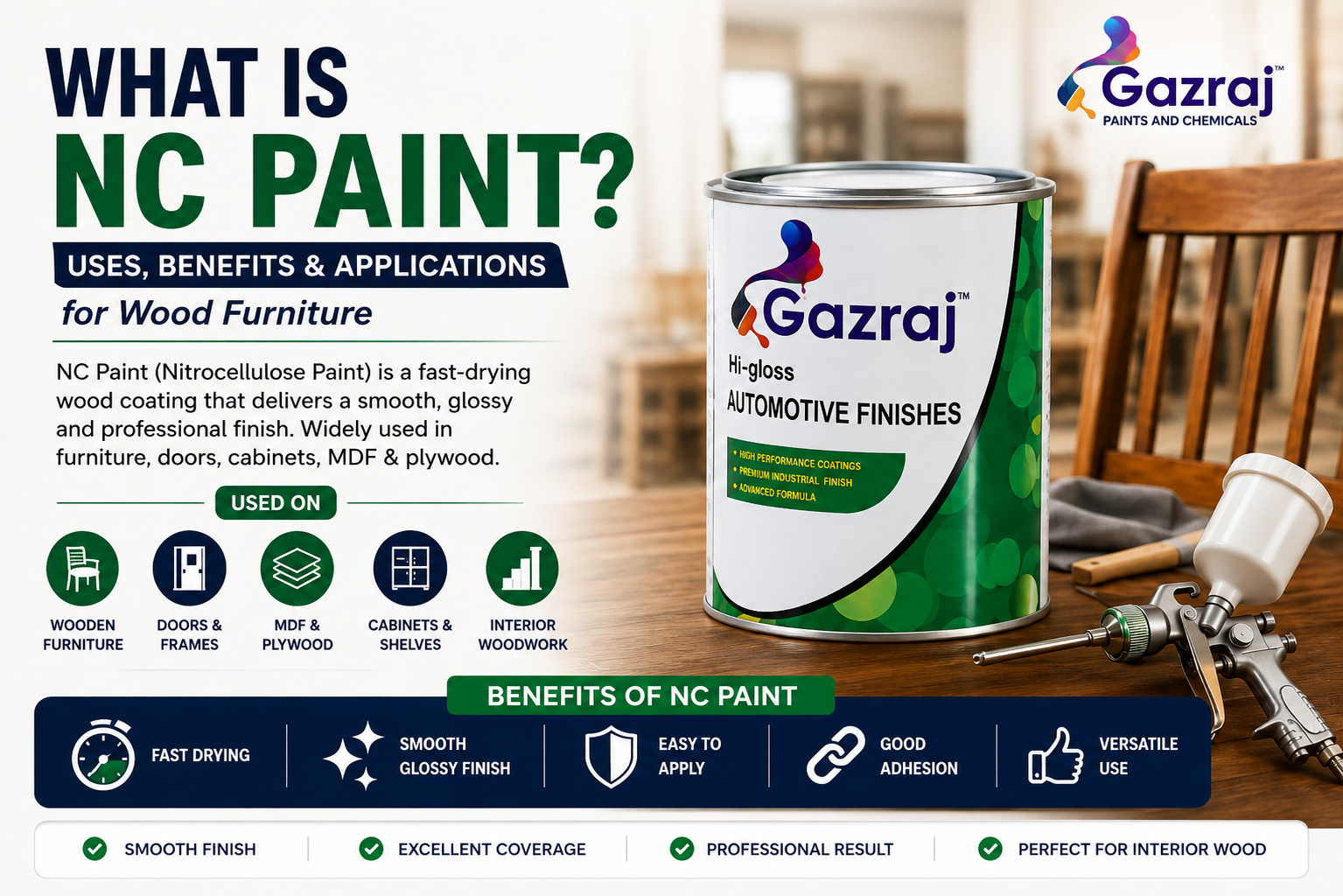
Choosing the right paint or coating for wooden furniture plays an important role in achieving a smooth, attractive, and professional finish. Furniture manufacturers, carpenters, interior contractors, and woodworkers require a coating that is easy to apply, dries quickly, and provides a refined appearance.
One popular option used in the furniture and wood-finishing industry is NC Paint. Known for its fast-drying properties and smooth finish, NC paint is widely used on wooden furniture, doors, cabinets, MDF, plywood, and various interior wood surfaces.
But what exactly is NC paint, and why is it commonly used for furniture finishing?
In this guide, we will explain what NC paint is, its uses, benefits, applications, and how to achieve a better finish when applying it to wooden surfaces.
What Is NC Paint (Nitrocellulose Paint)?
NC Paint, commonly known as Nitrocellulose Paint, is a fast-drying coating widely used for wood and furniture finishing. Nitrocellulose-based coatings are valued for their quick drying, ease of application, and ability to produce a smooth decorative finish.
NC paint systems are commonly used by furniture manufacturers, carpenters, professional painters, and wood-finishing contractors where fast application and an attractive surface finish are required.
Depending on the finishing requirement, an NC coating system may include products such as:
- NC Paint
- NC Lacquer
- NC Sanding Sealer
- NC Thinner
- Wood Stain
- Suitable primers or base coats
When these products are used correctly as part of a compatible coating system, they can help create a smooth and professional furniture finish.
Why Is NC Paint Popular for Wood Furniture?
Wooden furniture requires more than just colour. A good coating system should enhance appearance, provide an even finish, and allow painters or manufacturers to complete finishing work efficiently.
One of the major advantages of NC paint for wood is its fast-drying nature. This can reduce waiting time between compatible coats and help improve productivity in furniture workshops.
NC paint is also popular because it can provide a clean and smooth appearance when the wooden surface is properly prepared.
For furniture manufacturers handling multiple pieces every day, faster drying and convenient application can be particularly useful.
Benefits of NC Paint for Wood Furniture
1. Fast Drying
Fast drying is one of the most recognised benefits of NC coatings.
Compared with coating systems that require longer drying periods, an NC system can allow the next stage of finishing to begin sooner when applied under suitable conditions.
This makes it particularly useful for furniture workshops and production environments where turnaround time matters.
2. Smooth and Attractive Finish
A properly prepared surface combined with the correct application technique can produce a smooth and visually appealing finish.
This makes NC paint suitable for furniture where appearance is an important consideration.
3. Easy Application
NC coatings are commonly applied using spray equipment, making them suitable for professional furniture-finishing operations.
Correct thinning, spray pressure, distance, and application technique are important for achieving an even coat.
4. Suitable for Different Wooden Surfaces
NC paint systems can be used for several properly prepared wood-based surfaces, depending on the specific product and coating system.
Common applications include:
- Solid wood
- Wooden furniture
- MDF
- Plywood
- Cabinets
- Wooden doors
- Decorative wooden components
Always check the specific product instructions and surface compatibility before application.
5. Efficient Furniture Production
Because NC coatings dry relatively quickly, furniture manufacturers can reduce waiting periods between stages of production.
For businesses working with larger quantities of furniture, this can contribute to a more efficient finishing process.
6. Different Finish Possibilities
Depending on the product system selected, NC coatings can be used to create different decorative appearances.
The final appearance depends on the specificNC product, surface preparation, number of coats, application technique, and compatible finishing products used.
NC Paint Uses and Applications
NC paint and related NC coating products are commonly associated with professional wood finishing.
Wooden Furniture
Tables, chairs, beds, wardrobes, cabinets, shelves, and other wooden furniture can be finished using a suitable NC coating system.
Doors and Frames
NC coatings may be used on properly prepared interior wooden doors, frames, and decorative wood components where the product specifications allow.
MDF Furniture
MDF is widely used in modern furniture manufacturing. With appropriate preparation, sealing, sanding, and a compatible coating system, NC products can be used to create a smooth decorative finish on MDF.
Plywood
Plywood furniture and panels can also be finished with suitable NC products after proper surface preparation.
Office and Commercial Furniture
Desks, cabinets, counters, display furniture, and other interior commercial woodwork may also use NC finishing systems.
How to Apply NC Paint on Wood Furniture
A good finish depends heavily on surface preparation. Applying paint directly over an uneven, dusty, oily, or poorly prepared wooden surface can affect the final result.
A typical process may include the following steps.
Step 1: Prepare the Wooden Surface
The surface should be clean, dry, and free from dust, grease, wax, and loose material.
Any cracks, nail holes, dents, or other imperfections should be repaired using a suitable wood filler where required.
Step 2: Sand the Surface
Sand the wood appropriately to remove roughness and create an even base.
After sanding, remove all sanding dust before proceeding.
Step 3: Apply Wood Stain if Required
If a particular wood shade or decorative grain effect is desired, a compatible wood stain may be applied according to its instructions.
Allow it to dry properly before proceeding with subsequent compatible coats.
Step 4: Apply a Suitable Sanding Sealer
A compatible sanding sealer can help prepare the surface for subsequent finishing coats.
Once dry, sand the surface as recommended to achieve a smooth base.
Step 5: Prepare the NC Paint
Prepare the paint according to the manufacturer’s instructions.
If thinning is required, use the recommended compatible thinner and follow the specified mixing or thinning ratio. Avoid assuming that the same thinner ratio is suitable for every NC product.
Step 6: Apply the Paint
NC coatings are often spray applied in professional furniture-finishing work.
Apply controlled, even coats rather than excessively heavy layers. Follow the product’s recommended flash-off and recoating intervals.
Step 7: Allow Proper Drying
Although NC paint is known for fast drying, actual drying time can vary depending on:
- Temperature
- Humidity
- Ventilation
- Film thickness
- Product formulation
- Application method
Always follow the drying and recoating instructions supplied with the specific product.
NC Paint vs Other Furniture Finishes
There is no single coating that is best for every furniture project.
NC paint is often selected when fast drying, ease of application, and a smooth decorative finish are important.
PU coatings may be considered where different performance characteristics or higher resistance are required, depending on the product system.
Melamine finishing systems are another option commonly used for wooden furniture and decorative woodwork.
The correct choice should therefore depend on the substrate, required appearance, expected use, application environment, budget, and performance requirements.
NC Paint vs PU Paint
NC and PU coatings are both used in wood finishing, but they have different characteristics.
NC coatings are particularly recognised for quick drying and convenient application. PU systems are often selected for applications requiring different levels of durability, chemical resistance, or surface performance.
Instead of choosing only by price, consider where the furniture will be used and what performance is expected from the finished surface.
Tips for Getting a Better NC Paint Finish
For professional-looking results, pay attention to the complete finishing process rather than only the final coat.
Some important practices include:
- Clean the surface thoroughly before painting.
- Repair cracks and imperfections before finishing.
- Sand the surface evenly.
- Remove dust after every sanding stage.
- Use compatible products within the coating system.
- Follow the recommended thinner ratio.
- Avoid excessively thick coats.
- Maintain suitable ventilation during application and drying.
- Follow the manufacturer’s technical instructions.
- Test the coating system on a small area when compatibility is uncertain.
Common Mistakes to Avoid When Using NC Paint
Even good-quality paint can produce poor results when applied incorrectly.
Using the Wrong Thinner
An incompatible thinner can affect application and finish quality. Use the thinner recommended for the particular NC coating.
Applying Heavy Coats
Trying to achieve full coverage with one excessively heavy coat can lead to finishing problems. Controlled coats generally provide better application.
Poor Surface Preparation
Paint cannot hide every defect in the underlying wood. Roughness, dust, dents, and poorly filled areas may remain visible after finishing.
Ignoring Drying Conditions
Humidity, temperature, airflow, and film thickness can affect drying. Allow the coating to dry according to the product instructions.
Mixing Incompatible Products
A finishing system may contain stain, filler, sealer, paint, thinner, and topcoat. Products should be checked for compatibility rather than mixing different systems without verification.
How to Choose the best NC Paint for wood
Before selecting an NC paint for furniture, consider:
- Type of wooden substrate
- Interior application requirements
- Desired colour
- Desired finish
- Application method
- Drying requirements
- Compatibility with sealer and thinner
- Required surface performance
- Manufacturer’s application recommendations
Professional furniture manufacturers should also consider consistency between batches and availability of compatible products for the complete finishing system.
Gazraj – NC Paint Manufacturer in India
Gazraj is an NC paint manufacturer in India providing NC paints and wood-finishing solutions for furniture manufacturers, carpenters, contractors, dealers, distributors, and professional users. At Gazraj Paints, we provide coating and finishing solutions for furniture manufacturers, carpenters, contractors, dealers, distributors, and professional users.
Our product range includes solutions for different stages of wood finishing,including NC Paints, Thinners, Wood Stains, Wood Fillers, Sanding Sealers, PU Paints, and Melamine Systems.
Selecting compatible products and following the recommended application process helps achieve more consistent and professional finishing results.
NC Paint FAQs
What is the full form of NC Paint?
NC commonly refers to Nitrocellulose in the context of NC coatings and lacquers.
Is NC paint suitable for wooden furniture?
NC coatings are widely used for furniture and interior wood finishing. Suitability depends on the particular product, substrate, required performance, and application conditions.
Can NC paint be applied on MDF?
A suitable NC coating system can be used on properly prepared MDF when the product is intended for that substrate. Proper sealing and sanding are particularly important for obtaining an even finish.
Does NC paint dry quickly?
Fast drying is one of the key characteristics associated with nitrocellulose coatings. Exact drying time varies by formulation and environmental and application conditions.
Which thinner should be used with NC paint?
Use a compatible NC thinner recommended by the coating manufacturer. The required ratio can vary by product and application method.
Is sanding necessary before applying NC paint?
Proper sanding is generally an important part of wood finishing because it helps create a smooth and even surface for subsequent compatible coats.
Conclusion
NC Paint remains a widely used option for professional furniture and wood finishing because of its fast-drying characteristics, convenient application, and ability to produce an attractive decorative finish.
However, achieving a professional result depends on much more than choosing the paint itself. Proper surface preparation, sanding, compatible sealers and thinners, correct application, and suitable drying conditions all contribute to the final appearance.
For furniture manufacturers, carpenters, interior contractors, dealers, and other professional users, choosing the right NC coating system can help improve finishing efficiency while delivering a clean and consistent appearance.